This is probably the best book I’ve read this year (though it was published 2019). It’s certainly my most recommended. You should probably stop reading and just pick up a copy. I found it through this reading list from the Cosmos Institute — Jason Crawford’s pick.
The text has added historical context and perspective on the ideas that permeate discussions of environmental challenges and technology. On the whole, my reactions are more questions and newfound curiosities than anything else, though I’ll reflect on favorite aspects here.
One strength is in how much it combines biographical documentation with calm, detailed science communication and thoughtful commentary. Mann works descriptively — sharing a kind of quest with the reader — and only making evaluative claims about the two main characters once the context and facts are thoroughly conveyed. The book is accessible — and at times quite familiar — it engages with the contemporary conceptual landscape around environmental challenges by looking at the historical roots. Yet, while familiar, no perspective is quite what I expected at the outset — the factual and historical reporting is detailed, thorough, surprising, and engaging. What a delight.
It’s a bit like a dual-biography — holding up, side by side, the lives of Norman Borlaug (the “Wizard” archetype) and William Vogt (the “Prophet”). More than that however, Mann uses these two representative and influential templates as lenses on contemporary challenges (energy, water, food, air/climate).


Borlaug — often dubbed ‘the father of the green revolution’ — bred high-yield disease and weather resistant wheat, preventing millions of deaths (The Wall Street Journal attributed “perhaps a billion” in 2007) in Mexico, India, and Southeast Asia. His approach (that of the Wizard) might be characterized as using technology to combat scarcity.
William Vogt popularized many of the key concepts of the modern environmental movement (e.g. carrying capacity and ecological limits), largely through the text Road to Survival. He spent his life warning of impending ecological disaster if we did not slow population growth and learn to minimize our impact on the systems around us — hence “The Prophet.”
Mann’s book reads as sincere, thoughtful, and deeply researched, but it is also clearly strategic. By selecting emblems of two competing philosophies, Mann recruits a large audience. His descriptive writing invites readers to learn more about both their own ideas and their opponents.
I initially found this irritating: Borlaug’s work saved many millions of lives. Vogt’s writing contributed to the intellectual foundation for anti-population campaigns resulted in millions of sterilizations (and, if heeded, would have ended Borlaug’s work). How could one approach them as equivalent sources of inspiration for environmental problem solving? Pairing them up seems to inappropriately imply moral comparability.
The approach makes more sense in hindsight. Most of the book documents their lives, ideas, and impact thoroughly. Only in conclusion, after describing what occurred, does the author provide an explicit assessment of each of the two characters, and it is much more compelling given the many preceding pages of methodical narration.
My favorite lines are a Borlaug-Mann dialogue:
He asked me if I had ever been to a place where most of the people weren’t getting enough to eat. “Not just poor, but actually hungry all the time,” he said. I told him that I hadn’t been to such a place. “That’s the point,” he said. “When I was getting started, you couldn’t avoid them.”
My favorite scenes, in turn, are of Borlaug growing up subsistence farming in a small Iowa town, then suddenly freed from that life by his parents’ acquisition of a then newly affordable Ford tractor. It makes plain the origin of his drive and persistence, as well as adds a useful dose of perspective on the impact of mechanized farm equipment and, more broadly, the extreme comparative convenience of contemporary industrial life.
Some important ideas…
“People pollute,” as Hugh Moore said. But more people ≠ more pollution. — ch. 8, p. 404
Population ≠ Impact. Mann walks through his own journey with this idea in chapter 8, including useful quotes from Vogtian thinkers Ehrlich (The Population Bomb) & Meadows (Limits to Growth) accompanied by a compelling list of counter examples. He compares the impacts of technologies (coal burning vs wind power) and lifestyles (meat consumption and automobiles) in Delhi, Copenhagen, and Tokyo, noting how they mediate a population’s impact. He also notes particular resurgences in environmental quality in developed countries despite population growth, including an increase in wild turkey range in the US, white tailed deer ubiquity, forest growth in the Northeastern US and Europe, air quality in Japan, & seals and dolphins in the Thames.
This idea is familiar to me, largely thanks to the eco-modernist perspective on using technology to ‘decouple’ development and environmental impact, but Mann illustrated it particularly well. In Where’s My Flying Car, J. Storrs Hall emphasizes this same idea repeatedly by offering a variety of technological strategies for such decoupling including but not limited to increased urban densification into taller buildings, as well as more ambitious dreams like ‘making earth into a park’ and living in the sky / space / planets etc. All three sources make the point quite well, if differently.
Biological ≠ Society. One of my main takeaways from the intellectual history Mann documents is in the disturbing (and disturbingly repetitious) consequences with which biological models are misapplied to human society and used to justify coercion. In chapter 2, Mann describes the 19th century version of this phenomenon:
Overstating the impact of Darwin, Wallace, and Malthus is not easy. Their ideas passed rapidly beyond economics and biology to become models for society. Some thinkers viewed evolution as a process of competition leading to progress … Others saw the races of humanity fighting for resources, and sought victory for their group. — p. 79
many of the racial alarmists were also leaders in the nation’s new conservation movement. … they found little difference between protecting forests and cleaning up the human gene pool. — p. 80
In what the Yale historian Timothy Snyder describes as “an extreme articulation of the nineteenth-century commonplace that human activities could be understood as biology,” Hitler viewed our species as a group of genetically distinct races warring for survival. Echoing Malthus, Hitler insisted that “regardless of how [any race] raises the productivity of the land…, the disproportionate population in relation to the land…remains.” As a result, the duty of Hitler and every other racial leader was to “reestablish an acceptable ratio between population and land area” — that is, to feed their ever-growing races by seizing an ever-greater share of the planet’s finite resources. — p. 81, footnote 3
In chapter 8, Mann walks through the late 20th century anti-population campaigns in which:
Millions of women were sterilized, often coercively, sometimes illegally, frequently in unsafe conditions, in Mexico, Bolivia, Peru, Indonesia, Bangladesh, and, especially, India. … More than 8 million men and women were sterilized in 1975 alone. — ch. 8, pp. 399–400
He also notes the consequences of China’s one-child policy:
Song pushed for the one-child program that was adopted by the government in 1980. Tens of millions — possibly 100 million — of coerced abortions occurred, often in poor conditions that led to infection, sterility, and even death. Millions more women were forced to insert IUDs or be sterilized. — ch. 8, p. 400
Mann emphasizes a particular dynamic at the root of these policies:
As a rule, anti-population campaigns were proposed by natural scientists: biologists, in the main, but also physicists and engineers. Opposition came from social scientists — anthropologists, sociologists, economists, and demographers. — ch. 8, p. 399
The Petri Dish. Mann leaves the reader with one more biological analogy to consider at the end: the petri dish. While the book focuses on two men and their vastly different approaches to environmental problems, Mann motivates both — and highlights some similarity — through contrast with a third perspective. Lynn Margulis, contra both Borlaugians and Vogtians, held that humans, like all other species, would inevitably expand until we consume all available resources and die — just like bacteria in a petri dish. If the Borlaugian strategy is to use technology to cultivate more resources then a Vogtian strategy is to reduce consumption to a rate that allows resources to replenish naturally. While wildly different approaches, both offer a choice where Margulis saw inevitable expansion and self-destruction:
Borlaug and Vogt, too, took sides in the dispute. Both believed that Homo sapiens, alone among Earth’s creatures, can understand the world through science, and that this empirical knowledge can guide societies into the future. From this point, though, the two men diverged. One of them believed that ecological research has revealed our planet’s inescapable limits, and how to live within them. The other believed that science could show us how to surpass what would be barriers for other species. — Prologue, p. 9
Carrying capacity. Mann walks through the history of this concept, which originally referred to ship ballast before being applied to wildlife management, then eventually used in broader environmental contexts thanks to Vogt’s Road to Survival. I hugely appreciate Mann’s elucidation of key concepts’ history & etymology and think it a good habit to emulate when evaluating key ideas framing important or contentious topics. My view on the notion of ‘carrying capacity’ going into the book was that ‘carrying capacity’ is a detached and static concept that does not usefully apply to human societies engaged in technological development. Mann seems to agree, but expresses it by documenting other intellectuals’ counters and providing thoughtful examples — in other words, Mann says it more thoughtfully than I thought it.
An environment → The environment. Vogt’s Road to Survival also introduced the idea of ‘The Environment’ as it is used commonly today: something global and unitary, that humans impact. Prior to his writing, ‘an environment’ referred to the conditions in which people lived and were impacted by — “forests, shorelines, marshes, and so on.”
Defining a word in a new sense seems academic and abstract, but its consequences are not. Until something has a name, it can’t be discussed or acted upon with intent … Without “the environment,” there would be no environmental movement.
Other sections of note…
Desalination. The story of the development of desalination is compelling and something I’d like to dig deeper into. It’s been on my mind since Samo wrote about it and Casey Handmer wrote about bringing water to the west. One of my favorite parts of the book and a good story — chapter 5.
Solar & the ‘soft path’. Mann provides some really useful history on the origins of solar power specifically and on the ‘hard path’ (Wizard’s approach) vs ‘soft path’ (Prophet’s approach) more broadly. It’s a useful set of lenses. It has always confused me that solar connotes solarpunk, soft-path, distributed, local, while it requires centralized mining, processing, and manufacturing in order to produce affordably. Will small modular nuclear reactors receive the same soft-path stamp of approval if they become affordable and are sent to power small, remote developments? I doubt it. The early soft-path associations of solar help explain this. See chapter 5 for discussion of the soft-path vs hard-path conceptual framing and see chapter 6 for energy specifically.
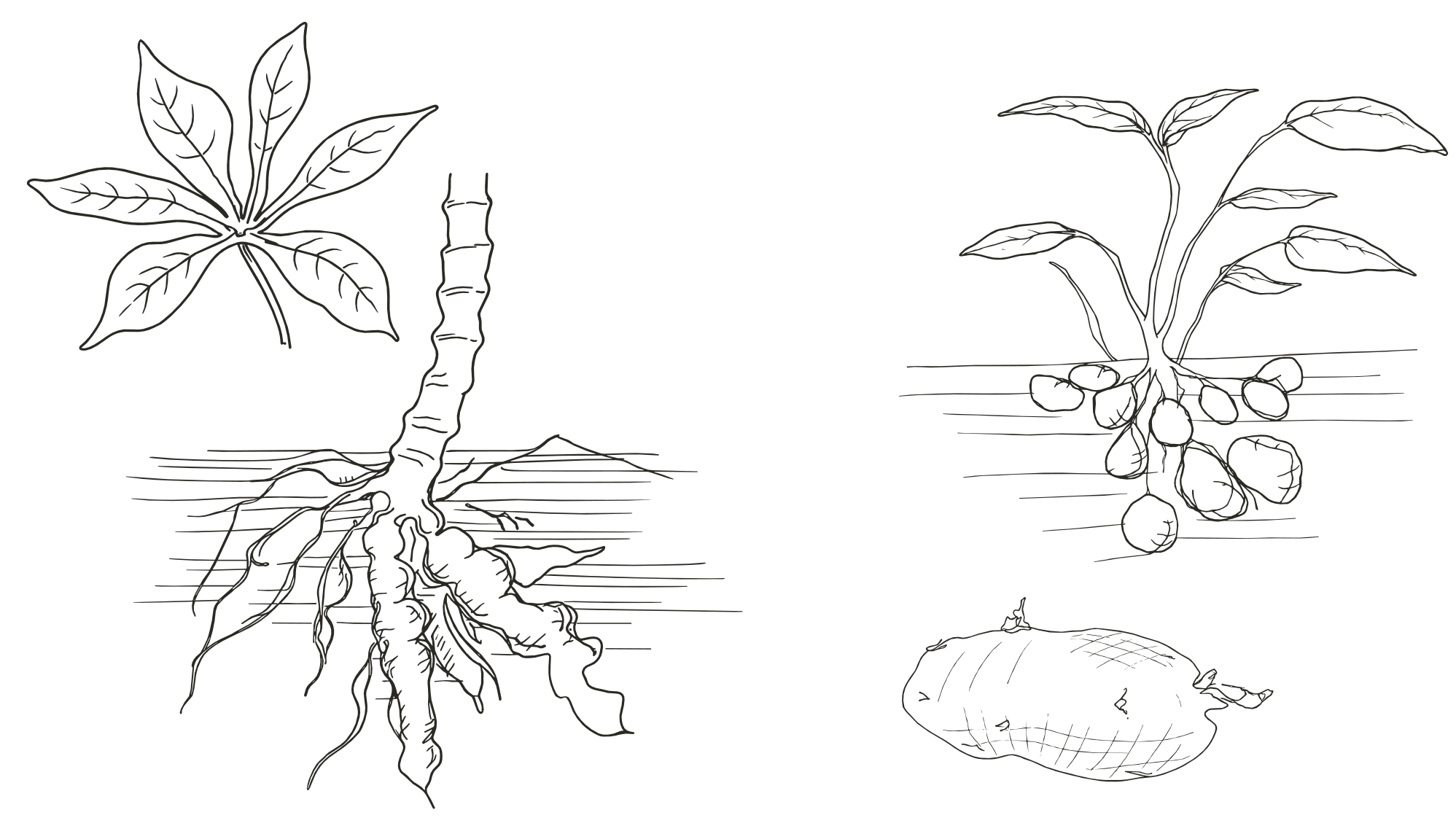

Cassava and potatoes. In chapter 4, Mann spends several pages discussing the calorie per acre density of various crops, noting the particularly high density of cassava and potatoes and the relatively low density of wheat and other staples. Cassava, grown at its best, yields 160k lb / acre annually — 50x wheat’s yield, though some of that difference is the water weight in the tubers. It’s a startling statistic and a thread I’d like to dig into further.
Briefly, I also appreciated learning about the C4 rice project in chapter 4 — an interesting and ambitious strategy and well communicated by Mann despite technical complexity. I also appreciated the list of ‘scientific doppelgängers’ (near-concurrent or near-miss simultaneous discoveries of the same phenomenon) in chapter 9 — some seemed like a bit of a stretch, but it is interesting how great minds can converge on problems and solutions despite being a world apart.
Process: line drawings by hand, after public-domain references; digitized via the workflow in the Dingbat Repo.