Wonderful! Potter argues that production efficiency is the “engine of civilization” and breaks down the different mechanisms of its improvement, while walking through a plenitude of interesting examples.
It’s an odd read in the sense of being unusually clear and structured. I remember reading one critical review-comment somewhere — I’d thought it was on Amazon, but can’t find it now — arguing that it reads too much like blog posts strung together as chapters of a book. Having read a good deal of Potter’s blog posts, I don’t think that at all. The topical clarity of each chapter — especially in the first half — does create a sense of walking through a series of distinct analytical lenses. Potter emphasizes the interactions between different mechanisms of efficiency improvement throughout (he is particularly pointed about the difficulty of predicting where the next improvement will come from and the risk of passively presuming steady improvements will arrive over time). The interrelatedness of different mechanisms is only brought into central focus by chapter 8, which is dedicated to bundles and chains of improvements. So you do have to wait a bit for all the pieces to ‘come together,’ but I think it’s better that way.
I found the clear topical segmenting immensely helpful, as it leaves me with a rather straightforward conceptual toolkit with which to appraise production processes. Given the inter-relatedness of different improvement mechanisms, intentional isolation of each mechanism seems essential to clearly construct the whole. Indeed, after reading the book, it seems that only through considering each and all of these mechanisms and their interrelationships in context of a specific process, can you hope to achieve something of a comprehensive picture.
The book is not at all a lean manual — the approach is much more conceptual and big picture (though grounded in many clear examples). Still, I imagine it would be practically useful to practitioners. For one thing, it clearly positions and integrates many of the different strains of thought around production efficiency. It’s a bit like walking into a well-organized garage: lean, DFMA, group technology, OR, industrial engineering, etc. Each tool or approach is labeled and usefully contextualized.
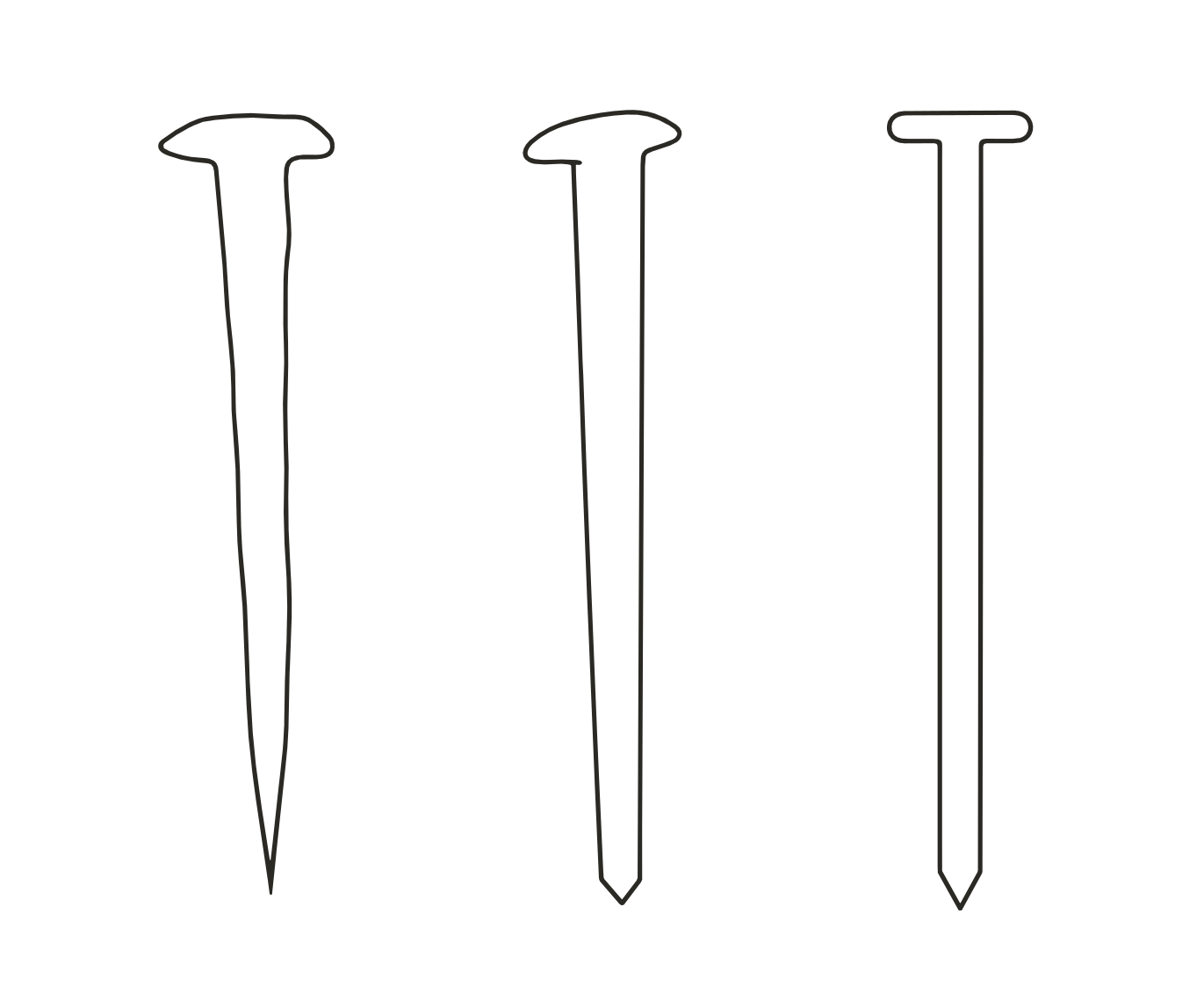
For a non-practitioner, the examples are key. Potter pulls on a seemingly endless repertoire of historical cases to illustrate different improvement mechanisms. It really increases your appreciation and leaves you with all sorts of stories to investigate. There are a few examples that are discussed repeatedly or in particular depth… the ribbon machine (bulbs), nail production, paper production, Toyota methods, and, of course, Ford’s assembly line.



If I were to make one request of the next edition, it’d be to pull one or two examples further through the text, so that one could see the relevance of all the mechanisms through the same single example. This happens to an extent, but it’s tricky — the best illustrations of a particular mechanism likely come from very different processes.
The other wish I have — and this would need a whole separate book I think, as it’d distract a bit from the clear conceptual architecture that Potter provides — is for more context on the people behind the story of efficiency. Potter names a great many interesting characters and indicates the contributions of a great many more, unnamed, participants. My favorite stories were of the Nintendo Game Boy creator Gunpei Yokoi, but I wanted to know more! More about him, and about Shigeo Shingo, Poka-Yoke, and TPS. What kind of personalities give rise to these changes? How do they see the world? Even the anecdotes about Ford’s decision-making and experimentation through the development and optimization of the production line showed a different and arguably more interesting or practically useful side of his person than is covered by popular narratives. Broadly, the stories about people looking at the production process and trying new things were most compelling when they carried a bit of detail about their personality and thinking at the time. More on the organizational cultures and sociological context would also be valuable.
Given these post-read cravings I plan to 1) look further into the people behind these many examples of improvement and 2) to take these mechanisms + lenses that Potter has established/described, run a single process through all of them, and document the learnings. It could be useful with anything from a simple daily process like making coffee, or something more speculative, or else as a lens on a given case in the history of production.
The book would make a particularly strong curricular text, as a kind of industrial literacy + history addition. I do wonder how the world would look if the book were widely read and the principles broadly understood — quite different, I think. Speaking for myself, I only wish I could have read it sooner. Every process I see day-to-day looks a bit different now.
Book outline
Introduction — Production efficiency as civilizational engine
- Examples: penicillin, agriculture, textiles, books / text
- Something may be discovered in a lab, but making it available at volume changes the world
- Source of efficiency includes technology, but it's more than that (see failures list)
- The book will investigate:
- basics and definitions (ch. 1)
- production methods and technology (ch. 2)
- cheaper inputs (ch. 3)
- lowering production cost with larger volume (ch. 4)
- removing unnecessary steps (ch. 5)
- improving reliability (ch. 6)
- improvements accumulating over time (ch. 7)
- one improvement unlocking others (ch. 8)
- continuous process convergence (ch. 9)
- cases where production costs have not fallen (ch. 10)
- possible future changes (conclusion)
Chapter 1 — What is a Production Process
- Defining example: bulb production
- 'Inputs transformed, through a series of steps, into finished product'
- 5 factors:
- transformation method
- production rate
- inputs / outputs
- buffer size & work in process
- output variability
- Continuous flow process as ~ ideal (often)
Chapter 2 — New Processes
- Transformation method ~ most important
- example: smithed nails > cut nails > wire nails
- other production factors are downstream of changes in transformation method
- Technology S-curves
- Production technology as a series of S-curves
- Newcomen, Watt engines example
- But it's more complicated than just an S in any case…
- multiple axes of improvement
- a new method may not be an exact substitute
- adoption is hard
- production technology can be non-transferable
- performance ceilings ambiguous > hard to predict, maybe no successor technology at all
- Mechanization — machines work poorly, then better, then well
Chapter 3 — Reducing Input Costs
- How to find a cheaper bundle of products?
- redesign the product > value engineering, DFMA
- redesign the process > operations research
- redesign the org structure > vertically integrate; compete; partnerships / suppliers of choice, etc.
- change location
- Increase output value
- Tradeoffs and coupling
- explore / exploit and a changing tech landscape
- TSCA aluminum example
Chapter 4 — Scale Effects
- Mechanisms of economies of scale (iron & blast furnace example)
- Cost = production volume ^ b
- b = 1, no economies of scale
- b > 1, DISeconomies of scale
- b < 1, economies of scale
- Mechanisms (5):
- 1 — fixed-cost spreading: blast furnace, land, labor; cargo ship; tool setup; economies of scope; cost cliffs
- 2 — geometric scaling: tanks, pipes, containers — often requires redesign to scale, so go slowly (e.g. nuclear)
- 3 — statistical scaling: electrical supply / demand example — dampens impact of variability
- 4 — influence-curve effects: bargaining power, better routes, supplier standards & selectiveness, etc.
- 5 — learning-curve effects
- + network effects — not exactly the same, but relevant (think social networks & airplane route networks)
- DISeconomies:
- admin costs — managers and internal coordination costs as an org grows
- demand effects — exhausted inputs; new customers far away (ore, labor in a given market)
- geometric diseconomies — skyscrapers; each floor costs more than the last
- statistical diseconomies — larger machines = more parts to break and stock
- Cost-curve shapes: "L"
- 'minimum efficient scale' (necessary to take maximal advantage of scale effects) — small for machine-tool production, large for airplane production
- Efficiency often relies on scale effects (e.g. learning curve + fixed-cost spreading — note overlap with division of labor and specialization)
- Large markets — falling transportation costs open large markets, which make larger production volume and lower costs possible
- False economies / diseconomies — rearranging a process can sometimes eliminate or diminish the need for large scale (e.g. TPS & lean, die-change efficiency); there are also false diseconomies (e.g. wind turbines, once expected to be optimal at small sizes)
- Bottlenecks are rate-limiting — critical path analysis
- Shifting scale landscapes — scale effects function in a dynamic landscape
Chapter 5 — Removing a Step
- Removing a step > value-adding (key transformations) vs. non-value-adding (scaffolding or support processes)
- How to differentiate? Take the customer's perspective. Does the customer care that you carried a part from step A to step B? Not really. That the components are fitted together into a car / chair / phone / whatever? Definitely.
- Potter is clear that the designations can be tricky and can change.
- Removing non-value-adding steps
- eliminate needless motion especially
- relevant people: Taylor, Gilbreth, Mogensen, Shigeo Shingo
- the 5-whys practice — ask why five times to get to the root cause
- Removing a value-adding step
- DFMA; changes in production technology
- plate-glass example
- interchangeable-parts example
- Can be tricky to differentiate value-adding from non-value-adding steps + sometimes depends on customer preferences / standards
Chapter 6 — Variability, Knowledge, and Control
- Variability > people and equipment are fallible / have tolerances (glass bulb, e.g.) and inputs can also vary
- 'Even effects that a process harnesses may not be well understood' (e.g. early steel production)
- Misalignment between steps in a process can result in buffers
- Destructive variation = defects; note that variation within tolerance can also still result in poorer performance
- Strategies: 1) eliminate the variation and / or 2) make the product or process robust to variation
- On 1: eliminate the variation
- historically, variation was managed by conservative, consistent (and secretive) maintenance of trade traditions — little change over time, different shops working in different ways
- 18th and 19th centuries, things change — experimentation, text to share methods, measurement instruments and better engineering drawings, developments in scientific knowledge
- A) eliminate the variation's source
- statistical process control — eliminate all assignable-cause variation and all you're left with is a (statistically visible) chance range of variation
- B) shield from variation
- enclosed factory or enclosed machine / process — isolation from or control of temperature, humidity, etc.
- C) compensate for variation
- control systems (human operator or automated feedback loop) — e.g. thermostat; 17th-century automation of mill variation; others
- Toyota Production System — reduce costs & increase quality by reducing labor and reducing inventory / work in process; just-in-time; kanban
- On 2: make a process more robust to variation
- relax needless tolerances
- redesign for wider tolerance
- selective assembly (match components with the same variation)
- pull system (vs. push)
- robust process design
- variability pooling (make a lot of shirts, THEN dye the colors)
- Variability tradeoffs — how to know if the cost of reducing the variability is worth it?
- Historical trend = greater control and less variability
- Good variability = tinkering, introducing mutations and selecting for favorable strains; exploration very valuable at the early part of the tech S-curve
- Lean & demand-prediction challenges > covid supply shortages
- lean / TPS = fragile, so you need to be proactive in preparing and monitoring for uncontrollable & inevitable variation
- Entropy, decay, and the man-made world constantly induce variability
Chapter 7 — Learning Curves
- Production costs fall with volume, generally by the same cost-reduction % with each doubling of volume. This is the 'learning curve' or Wright's law (though it isn't actually all driven by literal learning).
- can be factory-scale or industry-scale
- PV example, Boeing B-17 example
- Development may (and does) depend on many global events, BUT the relationship between volume and cost decline is surprisingly, predictably constant
- Skill accumulation, yes; also embedding learning in the process (e.g. making steps super simple for inexperienced operation, so the skill-development period is very short)
- also more general process improvement; there's always a ramp-up phase to a new process and there's always continuous improvement (though the errors may be extremely infrequent)
- Increased demand might also stimulate process R&D, make new technology viable due to larger scale, or incentivize DFMA
- these are distinct from improved process knowledge or skill development, hence 'learning curve' being a bit of a misnomer
- Sometimes decreasing production costs are the reason for the increased demand (vs. the other way around — can be hard to tell)
- Production technology might also improve over time independent of volume
- All in all, it's really hard to tease apart the different mechanisms behind the learning curve — which makes it difficult to take advantage of it in any simple way. You certainly can't just sit back and wait for costs to drop, but you also can't count on and pursue one mechanism in isolation. It's bundled and cumulative.
- 'Experience & volume create the opportunity for improvement'
- The technological S-curve and the learning curve are very similar — arguably the learning curve is just the second half of the S-curve (capping out at a steady-state plateau), while the first half is pre-production development
- Less-'coupled' products (fewer components that could bottleneck improvement) tend to have more intense learning curves
- Notably, learning curves are most pronounced in stable, continuous environments
- when disrupted, the learning curve is also disrupted
- new products start the learning curve over
- you need stability to isolate improvements from general variation in the process
- Limits of the learning curve
- different slopes at different times still happen all the time
- a key technology may or may not emerge
- Remember titanium (still expensive) vs. solar PV (now super cheap)
Chapter 8 — Bundles, Chains, and Feedback Loops
- We've distinguished a variety of mechanisms by which efficiency improves, but in actuality these often occur in bundles, where one process change triggers or involves multiple improvements
- Model T assembly line, e.g.
- interchangeable parts, e.g.
- bundles of improvements = improvements along several axes
- chains of improvements = one improvement unlocks or makes possible others
- Bundles
- production-method changes
- nails example (hand-wrought to machine-made); mills of steel sheet > reduced cost and improved quality simultaneously
- cutting a step out of a process can be thought of as a subcategory here
- e.g. pharma companies look for synthetic routes with as few steps as possible
- semiconductor manufacturing
- reducing process steps improved yields
- reducing work in process
- standardization
- different production methods have different strengths and weaknesses: think tradeoffs rather than universal process improvement
- production-method changes
- Chains
- removing a bottleneck or constraint
- cement kilns
- historically manually controlled — shifted to automatic or computer-based control in the '50s
- could then build and operate much larger kilns
- so automating kiln ops unlocked economies of scale
- cement kilns
- smoothing variation = often a prerequisite for volume
- HP process control — huge cost to stop the line at large volume
- mid-20th-century automatic control in chemical plants = scale increase
- one step may be the result of variation in a previous step
- e.g. manually finishing (pre-interchangeable) parts to fit into a gun
- e.g. machining of imprecisely cast or forged metal parts
- fix variation earlier on and you remove the subsequent corrective step
- one process improvement might make subsequent opportunities more legible
- e.g. lowering buffers makes problems more apparent
- generally, you have to fix the biggest problems to notice the sneaky ones
- automation requiring low upstream variation
- defective inputs can damage a machine where a human would (e.g.) notice and dispose of them
- e.g. the flyball governor made steam-engine output consistent enough for textile production
- e.g. mechanical corn pickers required consistent corn breeds (timing, height)
- chains of improvement can be long
- interchangeable parts > assembly line > scale effects & specialized machinery
- TPS; Yasuhiro Monden > multiple chains at work in TPS:
- increased quality via autonomation > higher sales and low service costs
- decreased workforce costs via flexible labor allocation via cross-training
- inventory reduction as a result of just-in-time production & low setup / changeover time (can produce different models on the same line, e.g. alternating & spreading out production, precluding the need for inventory buffers)
- TPS has to be implemented in its entirety to work — bits and pieces won't work the same way
- removing a bottleneck or constraint
- Ford and the Model T case
- Model N — inexpensive, high volume
- vanadium steel parts (light)
- interchangeable parts
- machine tools sequenced by assembly order
- Model T (5-seater, 3-point suspension, easier shifting)
- tolerances of 1/64"
- no need to test the engine before mounting
- inexpensive to maintain
- started shipping disassembled to regional assembly sites
- new factory — Highland Park: electricity, material starting high then moving down through floor holes
- special-purpose machinery
- huge volume
- machines arranged for material flow
- DFMA > costs drop > volume rises
- the assembly line
- starts with the flywheel-magneto dept. — from desks to line; 20 minutes to 13
- transmission — 18 minutes to 9
- engine — 594 minutes to 226
- chassis — 12.5 hours to under 6, then 3, then 93 minutes
- decreased inventory
- fewer production steps
- DFMA
- improvement chains — an efficiency engine
- machining > less work and skill > inexpensive > volume > specialized machines and assembly plants and a new facility, etc.
- Model N — inexpensive, high volume
- Summary
- two interrelated themes
- accumulation of improvements
- scale
- semiconductors example & AI
- two interrelated themes
Chapter 9 — Continuous Processes
- A tendency for production processes to converge on continuous processes — despite wildly different inputs, outputs, and steps
- Batch vs. continuous
- work in process and buffers are necessary in batch processes
- but a batch process may offer better economies of scale or more flexibility
- you might be able to change a batch process between runs to make a different version
- whereas a continuous process is likely already coupled to other steps and optimized for one very specific output
- batch processes are generally used at low volumes or very high volumes
- low volume batching, high volume continuous: chemical manufacturing, coffee roasting
- continuous process = high cost, which requires larger volume
- high volume batching: container shipping, semiconductor manufacturing
- economies-of-scale benefits + semiconductor flexibility between batches
- sometimes a blend: e.g. industrial juicing and Bessemer converters
- a step happens in batch, but on the whole it's automated and continuous
- parking-garage precast-concrete example
- low volume batching, high volume continuous: chemical manufacturing, coffee roasting
- TPS is kind of all about the flexibility of batch and the benefits of continuous
- group technology
- work is classified based on types of operations
- Continuous-process evolution
- flour mills
- nails
- increased size of market thanks to late-19th-century transportation — the book reference "Scale and Scope" seems interesting
- cigarettes, matches, screw cutting, mills, soap, photographic film, sugar, beer, toilet paper, chewing gum, candy, soda ash
- Model T takes this to a new level of product complexity
- then petroleum refining / cracking
- the Hall-Heroult process for aluminum
- Few facilities needed for large volume
- Typically a continuous process is about the end of the technical development
- e.g. paper making — Fourdrinier machines
Chapter 10 — Failures to Improve
- So far we've covered a lot of improvement examples (with e.g. the titanium exception), but many goods and services have not gotten cheaper over time, or have gotten more expensive (housing, healthcare, college tuition)
- A range of reasons
- lack of efficiency improvement, yes, but also:
- positional / status-oriented goods (e.g. Rolex and the like — scarcity is the point)
- artisanal / hand-made goods (inefficiency is part of the point)
- barriers to market entry (erected by "producers, governments, and other groups")
- Let's look at the cases where there's mainly a lack of efficiency improvement… like housing construction
- sure, zoning, licensing, unions, local opposition, price sensitivity, etc. all make it difficult
- even so, there have been lots of attempts to improve production efficiency that looked like they might work, but haven't. Why?
- Two possible categories of reasons for failed improvements
- 1 — Blocked paths
- technical limitations (titanium example)
- political limitations
- prescriptive vs. performance-based regulations (product needs to meet a certain standard of performance, but method-agnostic)
- crash-test example (performance-based)
- vs. tall timber (prescriptive reg change)
- stakeholder opposition
- plasterers' union vs. drywall
- plumbers vs. PVC
- trades vs. prefab
- dockworkers vs. shipping containers and port automation
- prescriptive vs. performance-based regulations (product needs to meet a certain standard of performance, but method-agnostic)
- market limitations
- e.g. EUV lithography machines — very small annual production
- e.g. early prototypes of a new car model
- as production costs fall, new markets open (e.g. solar PV)
- these three — technical, political, market — will intersect
- blocked paths and stability
- process improvement requires some stability
- if unstable, improvements may not be possible to accumulate
- reset learning curves due to constant changes
- can't align process steps
- costly buffers
- low automation possible
- requires skilled, expensive labor
- highly unpredictable environments > high or rising costs
- medical care: tons of variability
- in manufacturing you figure out what to do, then repeat and optimize it
- in medicine, each patient is a process of figuring out what to do
- car repair (contra production of a new car)
- medical care: tons of variability
- 2 — Added burdens
- regulation
- e.g. vehicle safety and fuel-economy requirements adding $6-7k between the '60s and the 2010s
- coal-generated electric power — 1970s — scrubbing equipment added
- diseconomies of scale
- exhaustion of accessible inputs
- labor gets more expensive over time — Baumol's cost disease
- productivity increases in some sectors put upward wage pressure on others
- 'nearly every industry must cope with these expanding burdens'
- regulation
- 1 — Blocked paths
- Building-construction case study
- construction costs have risen faster than inflation since the early 20th century
- productivity: labor-hours required per square foot of a US single-family home increased
- Germany, Belgium, Sweden, Norway, and France also have this problem
- Why? Many blocked paths of improvement
- process barriers
- largely craft-based, low automation; prefab and modular haven't reduced costs for single-family homes
- many tried, all failed (Lustron, Stirling Homex, Katerra, National Homes, Gunnison Homes, General Houses)
- Toyota Housing Corp — somewhat more prefab than in the US but still largely conventional
- trailer homes are doable, but moving away from that gets tricky
- process barriers
- Why?
- transporting from factory to site is hard (buildings are big, may require added supports to make the transported form stable)
- low dollar density
- small market: ~1 million starts annually (compared to 15 million cars or 100 million smartphones)
- high variability: site size and shape, soil, climate, infrastructure, access requirements
- work done outdoors, exposed to weather
- large, expensive equipment needed
- cyclical industry: variable demand
- low economies of scale
- low vertical integration
- new-process introduction is risky — high risk, low reward given the low volume
- bulk building materials are already mass-produced
- site-condition and permitting requirements
- cost of design for most products is many times the individual product cost (e.g. a new car model) — for a house it's maybe 5% or less, so not an opportunity for DFMA
- historical resistance to automation
- regulations ++
- Baumol cost disease — labor costs ++
Conclusion — The Future of Production
- We have cheap, abundant food, light, drugs (e.g. penicillin), electricity… incredible abundance thanks to the mechanisms of production efficiency
- Mechanisms: technological improvement, reduced input costs, economies of scale, removing steps, reducing variability, eliminating buffers
- All critical, but something is especially important about scale
- requisite to DFMA, automation, and process repetition & improvement
- Flexible equipment and information processing
- a flexible continuous process? e.g. inkjet printing vs. the printing press
- more broadly?
- 1 — requires equipment capable of flexible response (robots, milling machines)
- 2 — requires information processing to determine production steps
- computational-fluid-dynamics example & the Navier-Stokes equation
- Case study: home construction of the future
- homebuyer designs using the builder's software tool — AI puts it together given set criteria and shared data, with some manual adjustment at the end — takes a few hours
- automated foundation-install truck — steel screws
- humanoid-robot truck with construction equipment
- structure uses thin steel panels formed by the truck (a triple sandwich of insulation and utilities)
- foundation beams and girders — panels overlaid
- cladding attachments
- then interiors and landscape
- pictures and other data used instead of a home inspection
- all in 24 hours
- What a "continuous yet highly flexible construction process might look like"
- healthcare: maybe AI & biological simulation could reduce the drug discovery / development timeline & digitally simulate effects
- education: maybe software that tailors itself to the student
- Nothing about efficiency is inevitable. It takes work.